Any sufficiently advanced technology is indistinguishable from magic.
The origins of the company do not deceive: Trinnov is primarily an engineering company, with technology and innovation at its core.
Over the past twenty years we have not only developed strong expertise in signal processing, active acoustics, electronics and digital audio
but also towards computing and network technologies, from audio over IP to remote access and cloud processing.
From 2003 onwards, we have been developing our own Loudspeaker/Room Optimization technology, inventing the term acoustic Optimizationand redefining audio calibration standards across multiple applications in the professional audio industry as well as in consumer environments.
The Optimizer was primarily intended for studios. Trinnov built its reputation with this technology while winning thetrust of some of the most demanding sound engineers in broadcast, music, and post-production studios around the world.
The Optimizer has been gradually refined over the years and is now the only “digital room correction” system widely used throughout the production chain, from studios to some of the finest commercial and private cinemas. It is used daily in over 2750 studios worldwide to produce some of the content you enjoy every day.
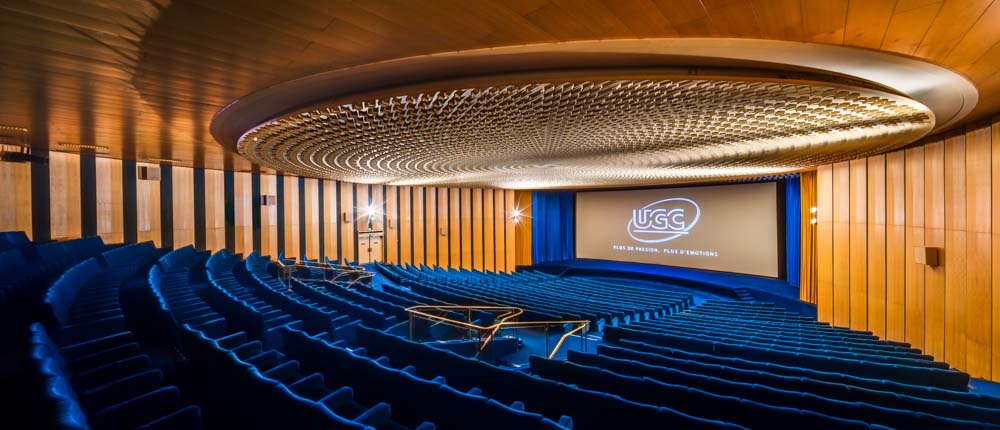
UGC Normandy, Paris, Champs-Elysées
Unique in many ways, the Optimizer relies on Trinnov’s iconic 3D Microphone to localize speakers and capture sound in three dimensions.
This microphone is designed by and unique to Trinnov, and each one is individually calibrated for accuracy to ensure the most reliable acoustic measurement. Indeed, because Trinnov feels nothing should be left to chance, they keep the entire signal path within a Trinnov-controlled environment (in their processor) rather than relying on external software, operating systems and audio interfaces.
The Iconic 3D Measurement Microphone
The Optimizer captures a huge amount of acoustic information in each measurement and performs time/frequency analysis to better understand and characterize the behavior of the speakers in the room. (Indeed, without the time domain, frequency response alone shows irregularities in response but doesn’t provide enough information to correct the errors properly, with the appropriate method.)
The highly detailed information is then processed using Trinnov’s proprietary algorithms, providing a full acoustic analysis of the room and revealing more information than any other automatic system. As an example, the acoustic graphs generated by the Optimizer for each measurement point include the phase response, group delay, and impulse response of each speaker, all of which are important to understand what is occurring in the room over time.
Most people understand that time-aligning speakers is important; but the point Trinnov has made since 2005 is that time-aligning frequencies is also essential for improving sound staging and transient reproduction. This is an area where passive acoustic treatment, although critical, cannot help.
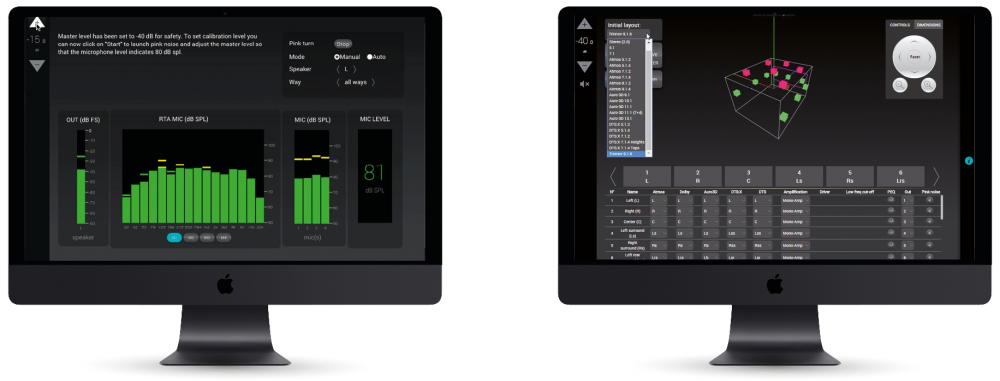
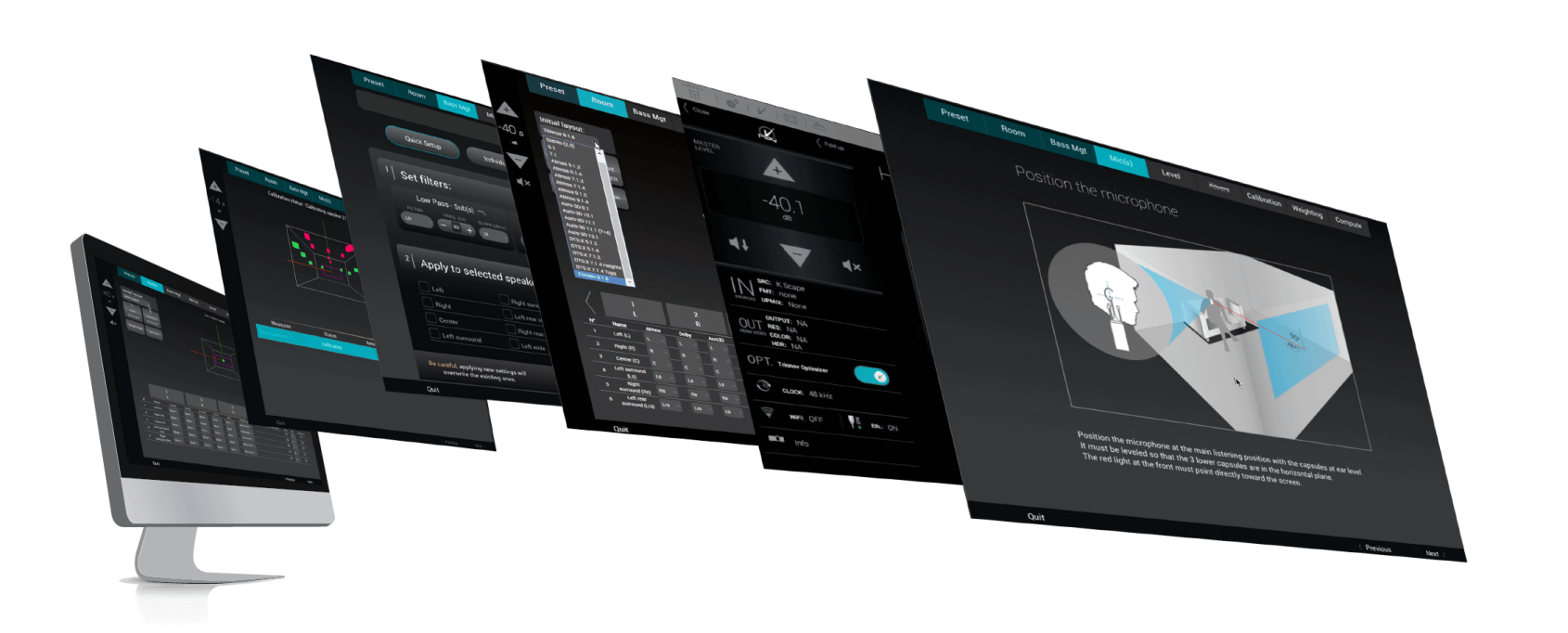
The sophistication of acoustic analysis performed by the Optimizer may sound like overkill for the consumer world. However, Trinnov is understandably proud of its pro audio background and believes consumers deserve no less. The Optimizer simply can solve problems that other systems cannot, and this is an area where Trinnov reigns supreme. Fortunately, Trinnov introduced a setup wizard to simplify the initial measurement and calibration process.
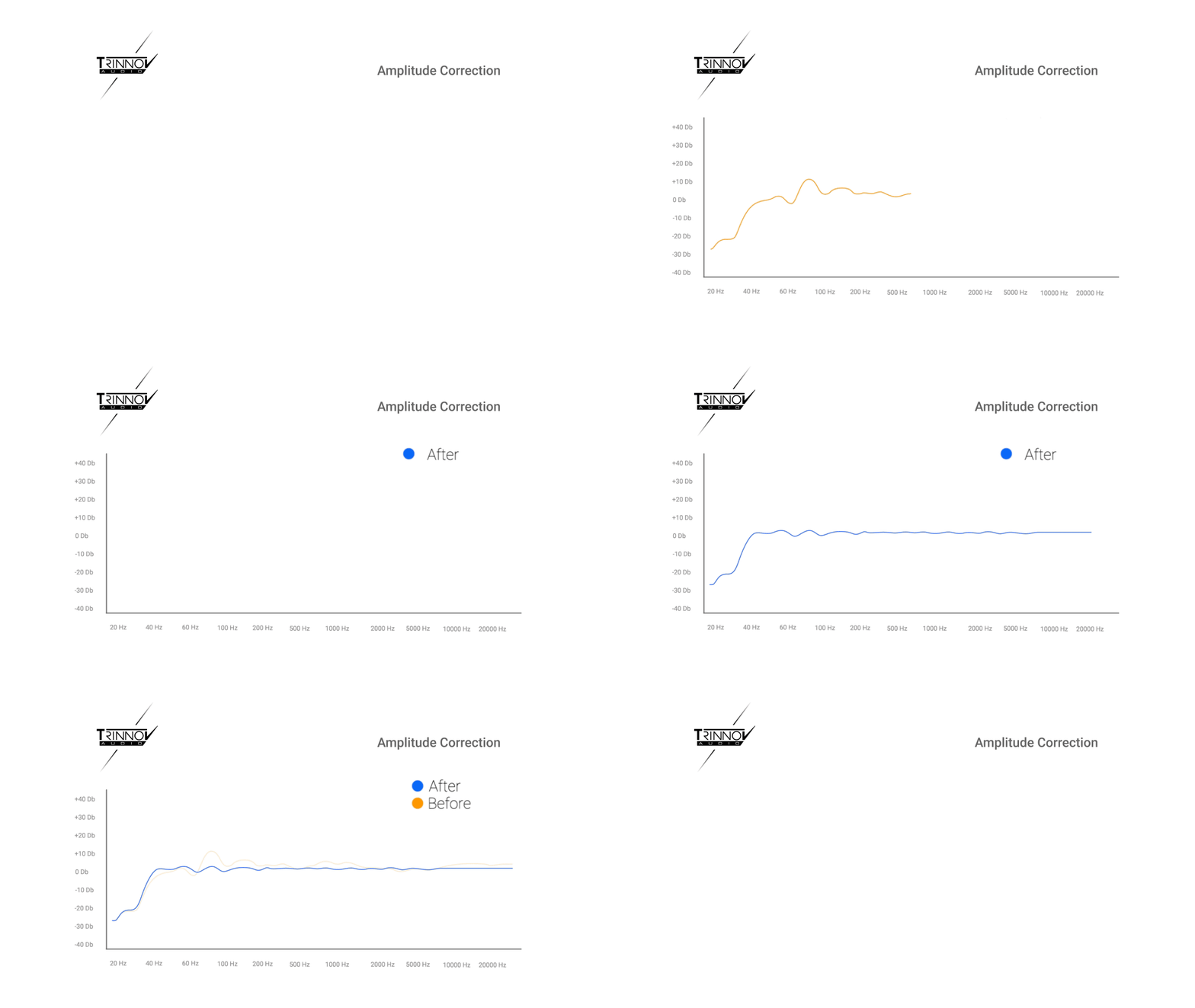
However, the manufacturer remains clear about the fact that every system is unique. Many acoustic parameters come into play, whether they are related to room acoustics, electro acoustics or psycho acoustics. The best possible results can only be achieved by a trained ear and experienced calibrator. This fact is not specific to Trinnov but is true for any system, regardless of its sophistication.
Trinnov really shines regarding the level of integration of the Optimizer within their products. The Optimizer doesn’t require external equipment beyond the microphone. It takes only a few clicks to make any system sing, whether you do it locally or remotely over the internet. Since the measurement data resides in the machine itself, subsequent tweaks are easily made, all with 64-bit floating-point precision.
All Trinnov products include the Optimizer technology.
What is WaveForming?
WaveForming completely redefines low-frequency reproduction in home cinemas: a new algorithm combined with home theater design guidelines and recommended practices to deliver an unprecedented level of performance and an entirely new bass experience, free of room modes.
The development of this new groundbreaking innovation from Trinnov Audio started more than 6 years ago and truly sets a new reference in low-frequency reproduction.
How does WaveForming work?
A unique approach
Attempts to improve low-frequency reproduction in small rooms, past or present, all have something fundamental in common: their sole intention is to attenuate the impact of the room's modes, usually with brute-force solutions. The natural laws of physics intrinsically limit each of these approaches.
WaveForming takes a different approach, much more logical and simple in principle, but extremely complex from a scientific perspective: attacking the source before it becomes a problem. In other words, instead of deploying heavy-handed treatments to mitigate the consequences of room modes, we limit the creation of room modes in the first place.
Advanced algorithm but soft processing
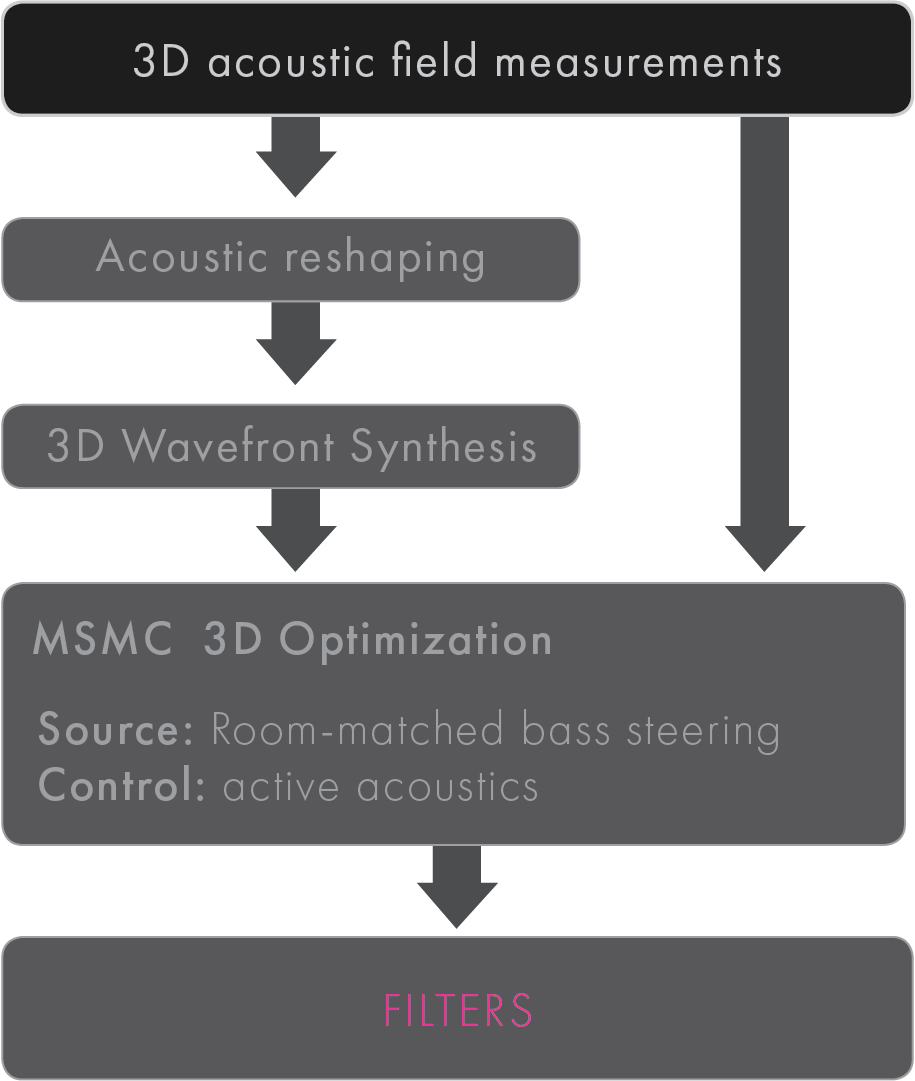
WaveForming relies on 4 major innovations, including the MSMC approach, arguably the most significant one.
MSMC stands for Multiple Sources, Multiple Controllers and truly differentiates WaveForming from any other low-frequency optimization technology.
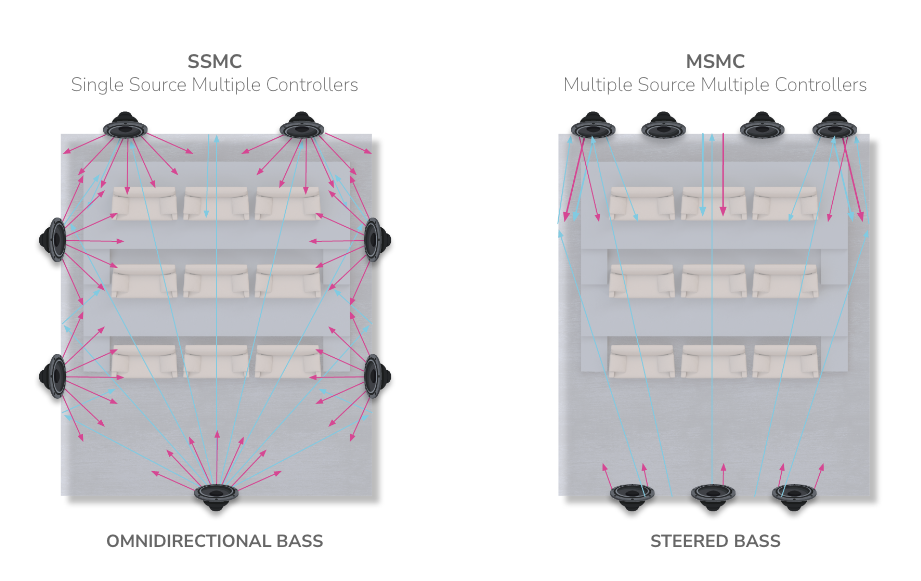
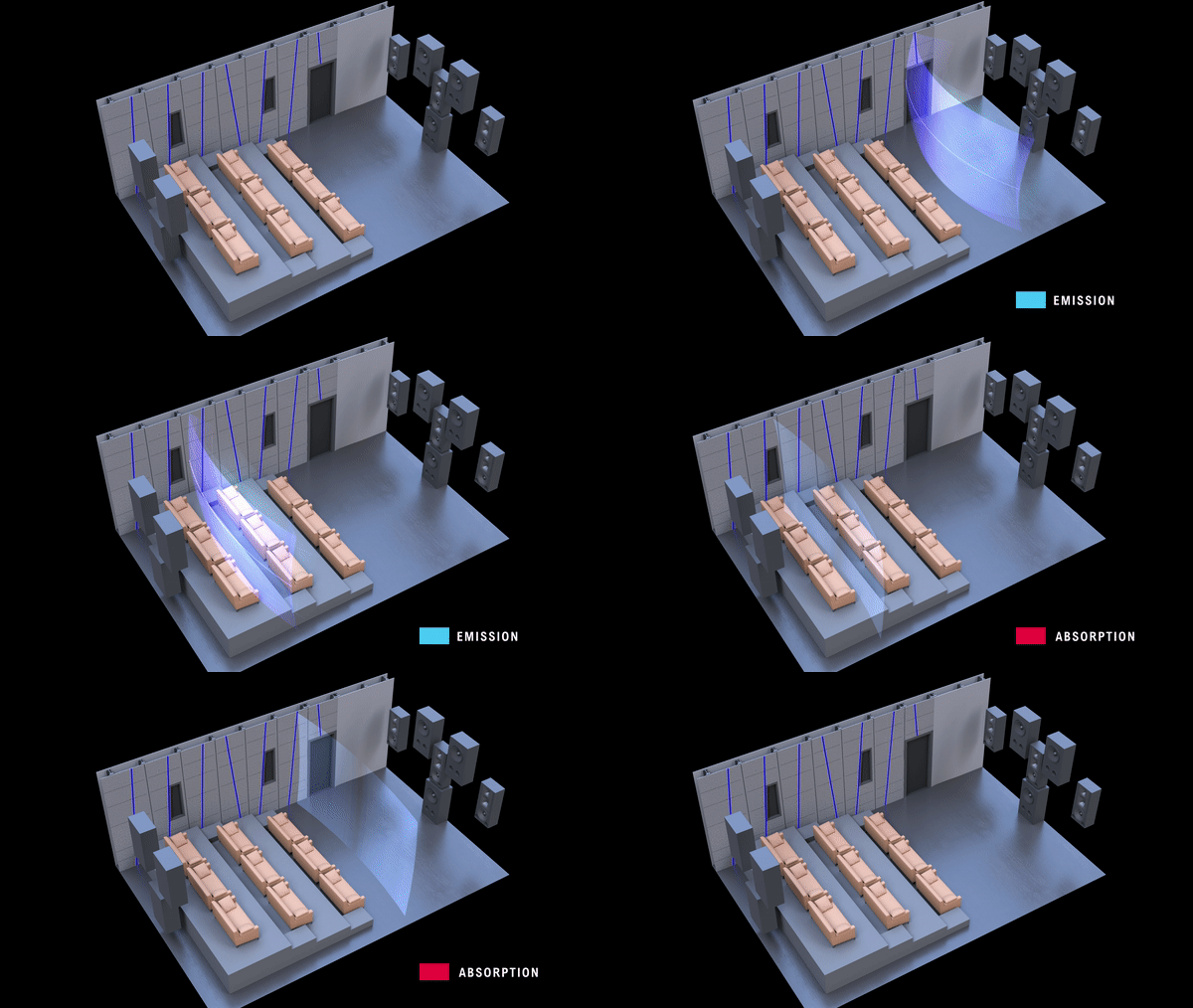
With other methods, each low-frequency source (usually a subwoofer) is driven and considered individually. WaveForming drives multiple sources individually and combines them together to create a single acoustic source.
This single acoustical source forms the appropriate wavefront (Wavefront Synthesis) for the acoustic environment. In practical terms, WaveForming steers bass towards the listening area and away from the most reflecting surfaces (via Acoustic Reshaping) to limit and control the amount of reflections created in the room.
In the graph above, we illustrate the difference between the SSMC approach and our MSMC approach.
With MSMC approach, every potential and relevant source of bass can also be used as one of the Multiple Controllers, and effectively absorb remaining reflections.
This whole process relies on specific 3D acoustic field measurements, which provides a 100% understanding of the room.
WaveForming only operates in the time domain and is combined with frequency-specific processing. This delivers very natural-sounding low frequencies which are free of any synthetic artifacts.
What are the Benefits of WaveForming?
New higher level of performance
WaveForming resets and expands the expectation in terms of bass reproduction.
The performance is no longer defined by the frequency (which mostly depends on the system design) but shifts the focus from frequency response to decay time (which previously used to be defined by the room acoustics only).
By effectively eliminating room modes, WaveForming dramatically reduces decay time down to 20Hz.
Attenuating the reverberation time of low-frequency sounds profoundly transforms the bass, adding more clarity, impact, and definition.
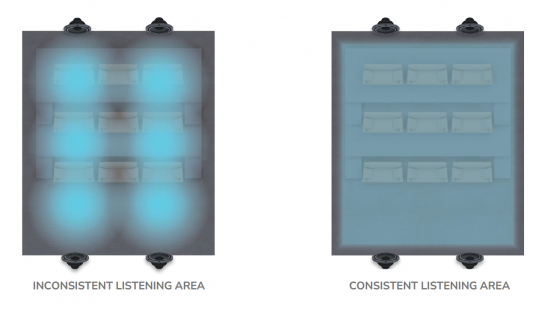
Seat-to-seat consistency
As previously mentioned, WaveForming virtually eliminates all low-frequency room modes, and therefore enables extreme consistency (frequency and amplitude) across the entire listening area. The fact that reflections are limited at the point of emission of the bass inherently lowers the variations in the room.
With WaveForming, you can exceed the new CEDIA RP22 level four requirements and achieve tight response across the entire listening area.
Predictable results
The most significant benefit of WaveForming might be that it provides predictable and repeatable results.
WaveForming is not just a simple algorithm that intends to improve the performance of any system (although it can be), rather, it’s a holistic approach that includes design guidelines, acoustic measurement and finally optimization of the solution.
The home cinema designer and specialist is part of the process, not replaced by it.
WaveForming from a practical standpoint
Different levels of requirements for different levels of performance
WaveForming is a technology that will be refined continuously over the next decade to offer even better performance, more features and greater flexibility.
Trinnov’s primary focus is currently to define a new reference in low-frequency reproduction. To truly change the way people consider low-frequency reproduction, there cannot be any compromise.
Regardless of WaveForming improvements in the future, the science of acoustics is clear: the best ‘Gold Level Standard' starting point is and will be based of a modified double bass array (DBA) layout.
Traditional DBA currently recommended for WaveForming
What to expect next from WaveForming?
Similar to the industry-defining speaker placement guidelines first released in 2018, Trinnov released subwoofer placement guidelines before CEDIA Expo 2023.
These new recommendations indicates how many subwoofers are required and how to position them not only in traditional DBA implementation but also with Trinnov’s specific recommendations.
Example of a more specific, less demanding WaveForming subwoofer implementation
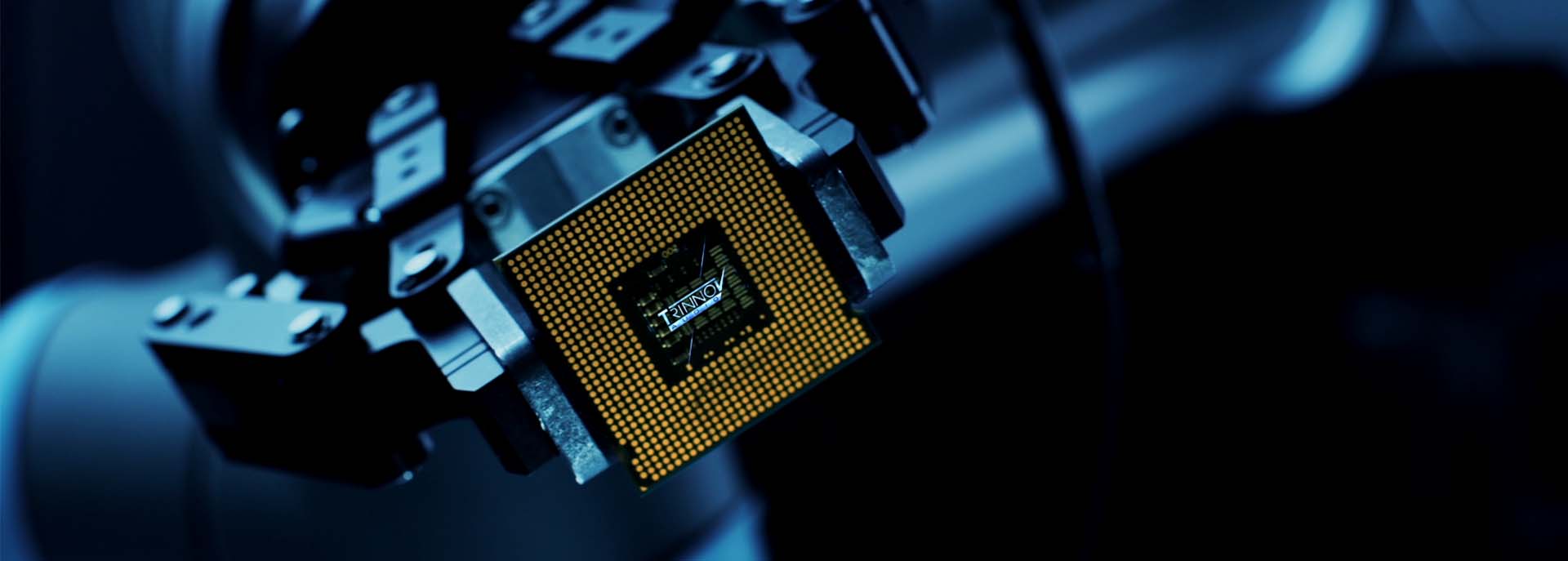
Leveraging the Power of Modern CPU
Our focus has always been on theimprovement of audio quality, with specific attention to spatial resolution, acoustic correctionandimmersive sound.
From day one, our initial research on 3D Sound requires a lot of computing power to perform advanced signal processing on a high number of channels. This is why we made the decision to rely exclusively on the increased processing power of computers…
Since then, the processing requirements kept on increasing across the entire audio industry with the emergence of digital audio, high sampling rate and immersive sound.
Today, most movies and music tracks are essentially produced "in the box": Digital Audio Workstations running on computers.
Yet, in the consumer market, Digital Audio Processors still use DSP, forcing them to choose between high channel count and processing resolution. Simultaneously, we can maintain full processing resolution across all channels up to 64 channels, from theatrical dubbing stages to research labs or exclusive private theaters.
All of our processing is performed with 64 bits floating-point precision, like the most demanding mastering plugins.
Our processors run our own Linux-based operating system, tailored specifically for professional audio applications: lightweight, efficient and most importantly extremely stable. We installed the first Trinnov Optimizer Processor in 2005. It has been running 24/7 and is still operating without a glitch.
Our Iconic 3D Measurement Microphone
The measurement microphone is one of the most critical components of any loudspeaker/room calibration system.
Trinnov’s sophisticated algorithms rely not only on extremely accurate acoustic measurements but also on the ability to localize the speakers’ positions and to detect early reflections.
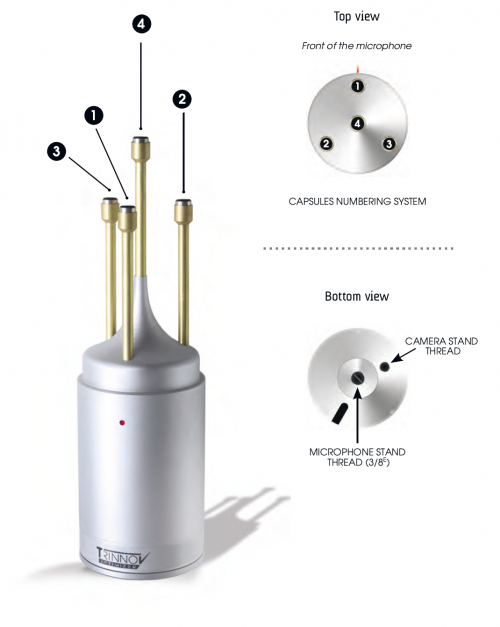
Our 3D microphone uses four mic elements in a precise tetrahedral arrangement. Each capsule is individually calibrated at the factory (±0.1 dB from 20 Hz to 24 kHz).
The resulting microphone calibration file is included in the microphone's box on a USB stick. The file is installed on the Trinnov product being employed and all the subsequent measurements are filtered through the calibration coefficient to ensure accuracy.
As each speaker is measured, the resulting sound waves pass through this array of microphones, hitting each one at a slightly different time. Based on this timing, we can triangulate the location of the speaker from which the sound arrived. By testing each speaker in turn, we build a three-dimensional map of where the speakers are relative to the mic (which is placed at the main listening position).
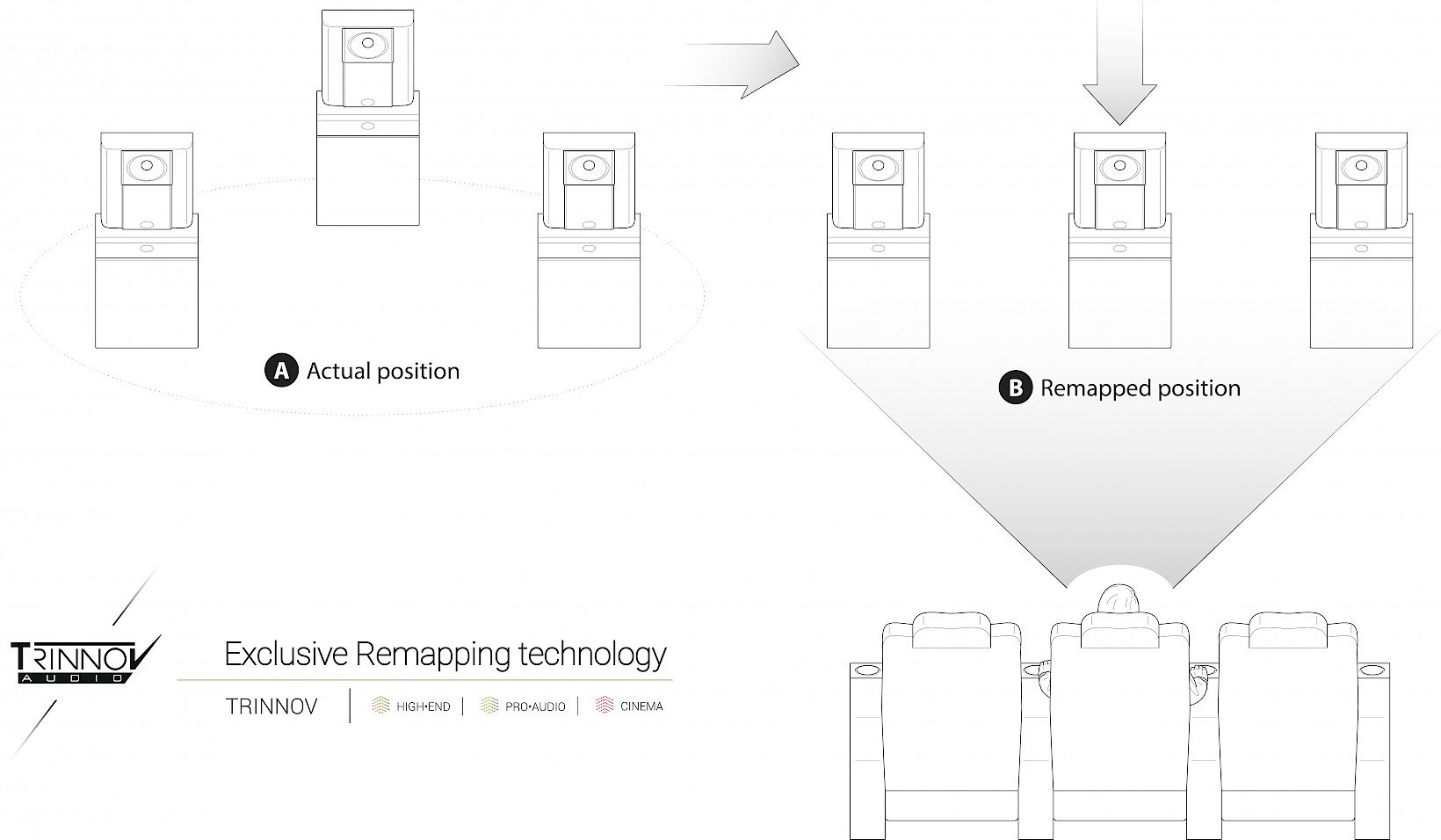
We can do this to within 2° of azimuth, 2° of elevation, and less than 1 cm of distance. We use this information to enable our proprietary Remapping technology, in which we translate from the theoretical rendering of the soundtrack to the specifics of your particular room. Remapping uses the two or three speakers closest to the intended location of a sound to create a phantom image of the sound coming from the correct direction.
Among other things, Remapping serves as a bit of a “Universal Translator” between the various audio formats. This is especially important in home cinemas since all three Immersive Audio formats disagree about the specific details of where you should place your speakers. We can solve that problem for you.
Measurement Positions
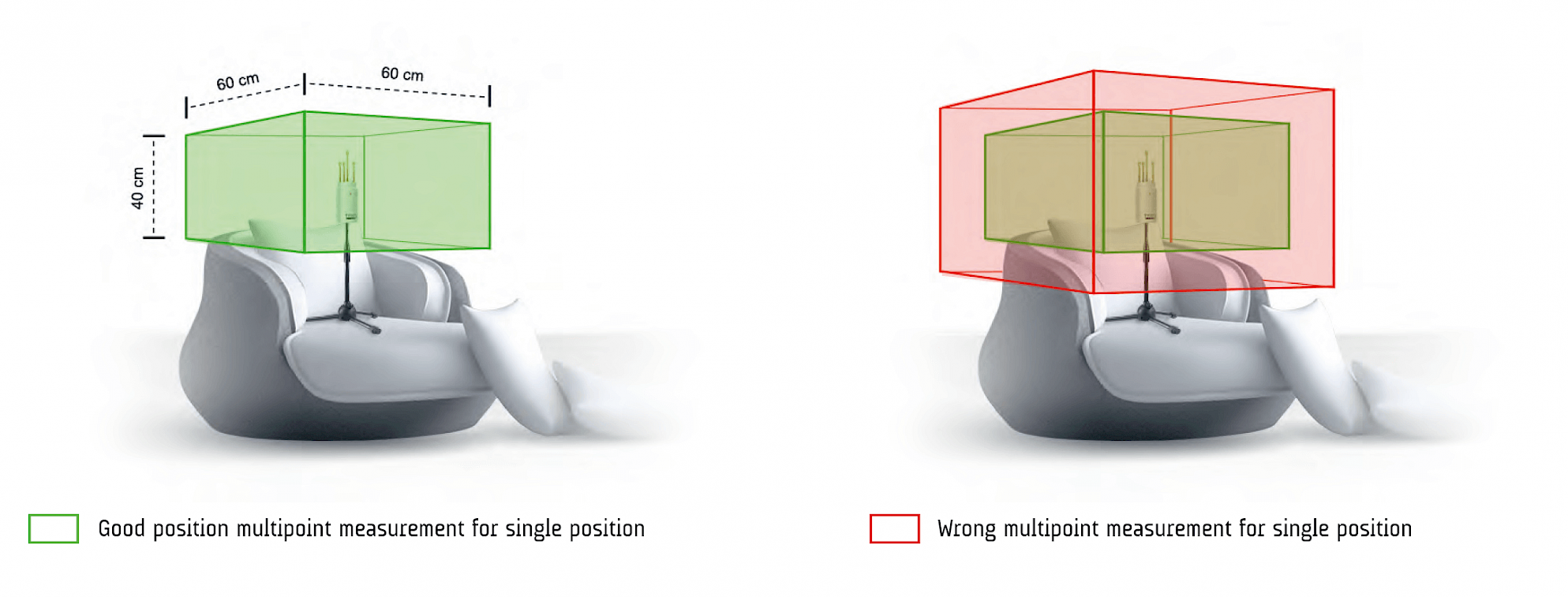
The following illustrations show a relevant and an irrelevant measurement areas for a single listening position. The idea is to perform measurements inside a volume that include head movements.
The instructions for the microphone placement concern the main measurement position, called reference point.
Additional measurements can be made ahead, aside and above the reference point within the volume described below.
For multi seats measurement, it is recommended to choose measurement locations included in the center area and avoid the positions the furthest away from the reference point.
Patented 3D Loudspeaker Remapping
Sound designers and mixers of major films have carefully constructed listening environments whose only purpose is to allow them to perfect the soundtracks on which they work.
By contrast, smaller studios are often quite challenged in terms of space and must place the speakers where they can. On the residential side, even the most luxurious home cinemas must contend with limitations like doors and windows, not to mention HVAC, lighting, and other architectural details that preclude “perfect” loudspeaker placement. Moreover, the three major movie soundtrack formats cannot themselves even agree on where the speakers should be placed. It’s a challenging situation.
Enter Trinnov’s patented Remapping technology: using a proprietary 3D microphone, the calibration process of a Trinnov processor builds a detailed, three-dimensional map of precisely where your speakers are located in the room.
The recording itself provides information about where various sounds should come from; we also know where your speakers actually are.
We can then translate from the theory of the soundtrack to the reality of your particular space.
This process minimizes the spatial distortions found in even the best studios and home cinemas, allowing you to hear what is actually in the recording.
Designed for Performance and Longevity
Historically, the decoding, processing and operating functions of an AV Processor have been distributed across multiple, specialized DSP chipsets, in rather complex and rigid architectures.
These architectures are developed and made available to consumer electronics brands by a handful of OEM manufacturers. In a market that is driven by fast-changing technologies, this approach inevitably leads to short product lifespans and early obsolescence. Unfortunately, this paradigm is ubiquitous… except for Trinnov’s unique Processor range.
Determined to push the boundaries of immersive audio and to fight obsolescence, Trinnov chose to develop its own platform, exclusive to Trinnov products and JBL Synthesis top-of-the-line processors.
Instead of repeatedly integrating third-party, short-lifespan technologies into new hardware products, Trinnov opted for true innovation, upgradeability, and longevity. Rather than following the typical multiple DSP approach described above, Trinnov created a modern and flexible architecture where decoding, processing, and operating functions are all handled by a single Intel multi-core processor. Part of this development was Trinnov’s own 64-bit operating system to host the software: TrinnovOS.
The benefits of Trinnov’s unique approach are perfectly illustrated by atypical development cycle.
When confronted with the need to update their products, other manufacturers must waitfor the availability of a new chipset and/or OEM board, and then go through a long hardware integration cycle, possibly forcing them to abandon an existing model and create a new one. By contrast, Trinnov achieves the same (often better) result faster, by simply incorporating the new feature or capability into a simple software update for the Altitude platform.
In 2020 at ISE, Trinnov consolidated its leadership with the first official production release of DTS:X Pro, a full year ahead of competition - as a free software update to all the owners of our 3D Codec package.




 However, the manufacturer remains clear about the fact that every system is unique. Many acoustic parameters come into play, whether they are related to room acoustics, electro acoustics or psycho acoustics. The best possible results can only be achieved by a trained ear and experienced calibrator. This fact is not specific to Trinnov but is true for any system, regardless of its sophistication.